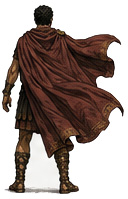
Crossing the Alps
The Alps were not unknown to the world. Merchants had crossed them. Shepherds had wandered their lower paths. Tribes had lived and fought in their shadow for generations. But those mountain roads belonged to trade, survival, and desperate travel, not to war. No army had ever looked upon those heights and seen a road fit for elephants, cavalry, and the weight of an entire campaign. Where others saw an impassable wall of stone and snow, Hannibal saw the one path Rome would never expect.
The mountain might decide the price of greatness, but it would not decide whether he continued forward. That choice was still his. And as the army climbed deeper into the shadow of the Alps, Hannibal kept his silence, straightened his posture atop the elephant, and fixed his gaze upon the road ahead—knowing that every step from this point onward would test not only his ambition, but the very worth of the dream for which he had asked so many men to follow him into the clouds.
The column moved on in a slow, uneven rhythm, broken only by the groan of leather harnesses, the tread of animals over stone, and the distant calls of officers guiding men through the narrowing road. Hannibal remained apart from all of it, present in body yet far removed in thought, as though some part of him had already climbed ahead into the cold silence of the higher passes. His expression gave little away, but the stillness around him had become too deliberate to ignore. Those who knew him only as a commander might have mistaken it for calm. Those who knew him well understood it for what it was: the silence of a man measuring consequences too great to be spoken lightly.
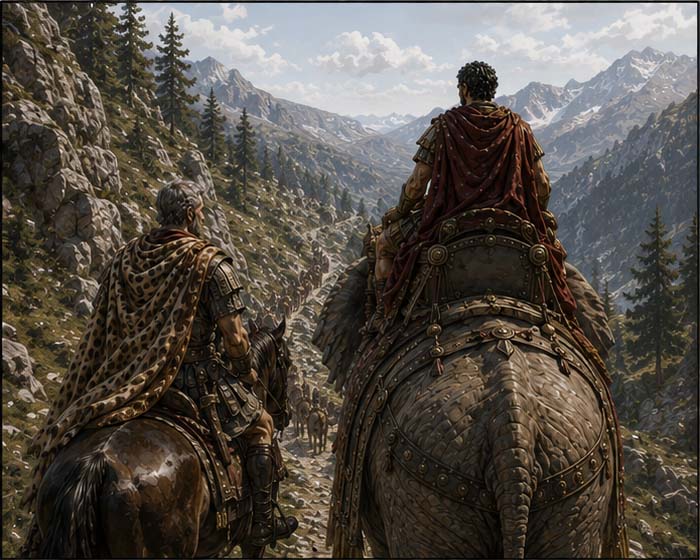
It was Hasdrubal who noticed it most clearly. Riding up from the flank of the column, he guided his horse over the rough slope until he drew close beside the elephant. For a while he said nothing, studying his brother’s face as the army continued its climb around them. He had marched with Hannibal long enough to know the difference between ordinary silence and the kind that came when the weight of command pressed hardest upon him. Hannibal’s eyes remained fixed on the road ahead, but there was a distance in them, as if he were seeing not the path before him, but the many futures hidden within it—some glorious, others ruinous, all uncertain. At last Hasdrubal broke the silence.
“You have scarcely spoken since we entered the mountain roads,” he said, keeping his voice low enough that it would not carry beyond them. “Your mind is somewhere beyond these slopes.”
Hannibal did not answer at once. He let the words settle between them while the elephant took another heavy step forward. For a few moments there was only the wind moving through the trees and the muted sound of soldiers climbing below. Then Hannibal turned his eyes slightly toward his brother, though not fully away from the pass.
“My mind is where it must be,” he replied quietly. “Ahead.”
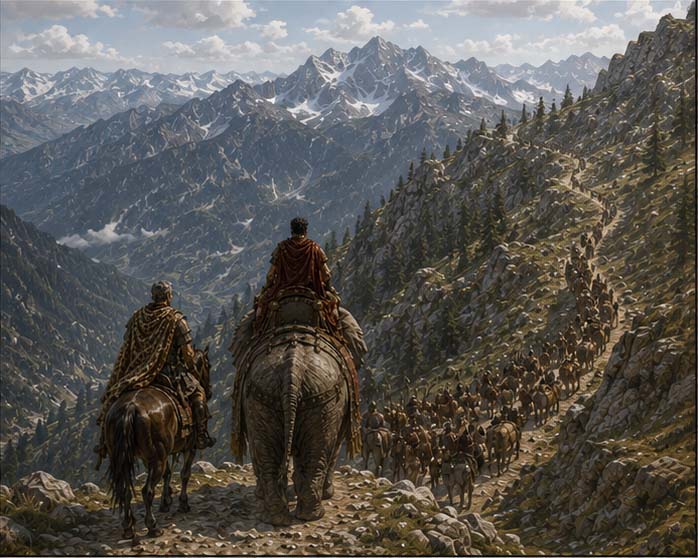
Hannibal’s hand tightened almost imperceptibly against the harness rope. For the first time, he looked fully at Hasdrubal. There was no point denying it to him. Of all those who rode beside him, Hasdrubal was among the few who could see through silence and command alike.
“I am thinking of all of it,” Hannibal said. “The men. The road. The cold that waits above us. The food we may lose. The animals that may not endure. The tribes that may watch these passes. The storms that can bury a column without warning. Every step we take now leads us farther from the world where mistakes can be repaired.”
Hasdrubal said nothing, allowing him to continue.
“In battle,” Hannibal went on, his voice low and steady, “I can see the shape of danger. I can read another commander, sense his fear, strike where he is weakest, change the field before he understands what has happened. But this…” He lifted his eyes toward the mountains. “This cannot be commanded in the same way. I can lead men against Rome. I can break armies. But I cannot order the mountain to spare them.”
The words hung between them more heavily than any confession of fear. Hannibal did not speak them as a man wavering, but as a commander facing the one truth that strategy could not master. Hasdrubal listened in silence, his face hardening with understanding.
“And yet we go on,” he said.
Hannibal looked back toward the column behind them. Soldiers climbed in patient lines, some speaking quietly to one another, some watching their footing, some glancing upward at the towering slopes with unease they tried not to show. There were veterans there who had followed him across half the known world. There were younger men who had never seen mountains like these. There were horsemen from distant lands, Iberian warriors, African troops, officers, servants, scouts, and elephant handlers, thousands of lives bound now to a single decision that had been his alone to make.
“Yes,” Hannibal said at last. “We go on.”
Hasdrubal waited, sensing there was more.
“For years,” Hannibal continued, “I have taught them to trust that every hardship serves a purpose. That every risk carries us closer to Rome. I have asked them to leave their homes, to bleed for victories they may never live to celebrate, to believe that what I see beyond the next horizon is worth the suffering it takes to reach it.” His gaze drifted again to the men below. “And they do believe it. That is what troubles me most. Not their fear, if they feared this road, I would understand it. But their faith.” He paused, and when he spoke again his voice had grown quieter. “Faith can lead men through impossible things. It can also lead them to die where they never should have been.”
Hasdrubal held his brother’s gaze, hearing in those words the burden Hannibal rarely allowed himself to voice. “If they follow you,” he said, “it is because you have carried them this far when no other man could have done it.”
“Perhaps,” Hannibal answered. “Or perhaps I have simply led them too far to imagine any road but mine.”
The wind sharpened as they climbed, carrying with it the first true chill from the heights above. For a few moments neither brother spoke. They rode side by side in silence, the mountain road bending slowly upward before them, the army pressing on below like a living current caught in the grasp of stone. At last Hannibal drew a breath and let it out slowly, as though setting his thoughts in order.
“This march will be a new chapter for every man here,” he said. “For some, it will be the road to glory. For others, the road to death. For all of us, it will be a passage into something no army of our world has yet dared to attempt in this way. There is no certainty waiting ahead, Hasdrubal. Only hardship, and whatever lies beyond it.”
Hasdrubal looked at him with the quiet understanding of a brother who had long since accepted the weight that Hannibal carried. “Then we will meet it as we have met everything else,” he said. “Not because it is certain, but because there is no other road left to us.”
The road into the mountains narrowed until it disappeared beneath towering cliffs, where the warriors of the Allobroges waited behind hastily built fortifications. From the heights they watched every movement below, confident that no army could force its way through the pass while they held the advantage of the mountain.
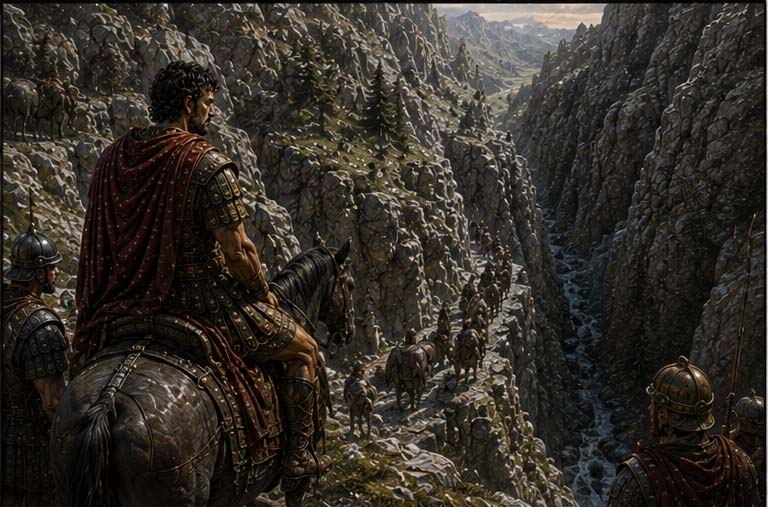
Hannibal ordered the column to halt.
He studied the rocky slopes for a long time without giving an order. The position was strong, but no fortress was without weakness. As the sun began to sink behind the peaks, he sent trusted scouts into the surrounding hills. Their task was not to count warriors, but to learn their habits.
He studied the rocky slopes for a long time without giving an order. The position was strong, but no fortress was without weakness. As the sun began to sink behind the peaks, he sent trusted scouts into the surrounding hills. Their task was not to count warriors, but to learn their habits.
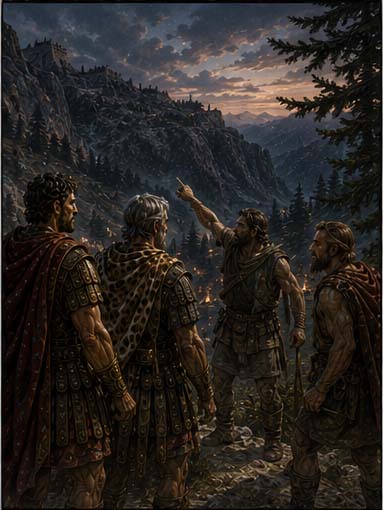
The scouts returned after nightfall with valuable news. During the day the Allobroges guarded the pass without fail, but each evening they abandoned their defenses and withdrew to their nearby camp, believing no army would attempt a night assault through the mountains.
Hannibal smiled only slightly.
This was maybe the first time he could shift his focus from the daily difficulties of the march to something more dangerous. He knew that, there were tribes, which might not welcome him. The army possess dangers due to the sheer size or the armed man but at the same time, the baggage was a prize who can claim it. The narrow passes, doesn’t let the army to have a strong stand for enemy. Therefore, even a small band of tribesmen creates a significant danger. This is not only the actual damage also the panic they can create among the animals as well.
He was well aware of all these and was all the time on alert for the unknown. Each night he could barely sleep. Many times, sleep doesn’t come. He finds his way through the army column and chatting with sentries and other commanders awake. The burden of dragging the army to the unknown, the dangers ahead and most important, the possibility of vanishing without anyone to notice what happened.
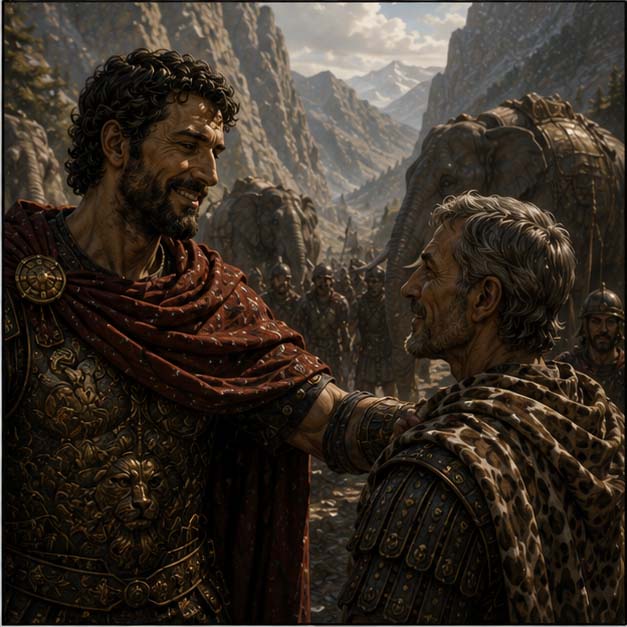
That’s why, when he smiled, it was more than just an expression. It was more like the relief which put a visible enemy against him.
He always thought the impossible. He knew, these mountain passes are very narrow and no army can get through in a single day. He needed to face the problem his own way. Instead trying to push forward, he decided to employ a different strategy.
He was very well aware that the mountain tribes are not pure warrior clan, they need to get everything from the landscape in order to survive. Which makes them warriors, farmers, hunters, gatherers and many more things at the same time. They could fight but with their traditional ways. In ancient history, having the high ground was the key for the engagements. These tribes adapted to this and put their strategy to ambush Hannibal’s army from high ground and take the advantage while the army was in full panic.
It worked in the past and it would work this time if it was another commander. Hannibal very well knew, he doesn’t have any advantage in the narrow passes where he can’t put his force fully. And, an enemy having the high ground in the rocky hills, might have a very heavy cost.
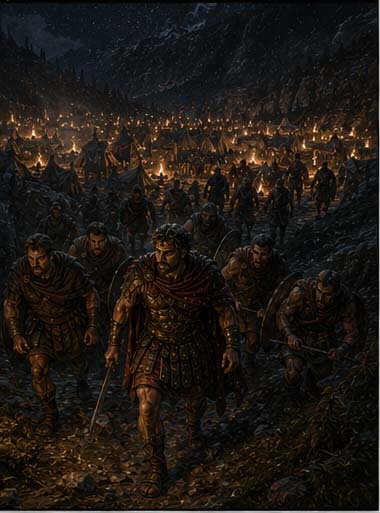
He listened carefully. Asked questions about every detail. He was very cautious. After a long discussion, he had a clear mind about what to do. Hannibal ordered Mago to choose 50 men and take the high ground to ambush the clan.
Mago did exactly what Hannibal ordered. He took his best and most seasoned veterans. Not only his and his men, also the whole army depended on him. There was no other pass or turning back.
Hannibal always trusted Mago. Although Mago was a cavalry commander, his was skilled and a brilliant commander. Mago learned a lot from Hannibal and started to think like him. He could understand the reason where other commanders see madness or negligence. He very closely watched Hannibal in Saguntum. He saw his tactics, his sheer will and not giving up even being wounded severely.
Hannibal was a role model for him. He always admired the loyalty of the soldiers. There was no difference between a soldier and Hannibal. Hannibal didn’t have luxuries like other leaders. He was sleeping with his men, eating what they are eating, enduring same challenges they were having. For these reasons, the soldiers had the most respect for Hannibal. Whatever comes from him, they took always without question. When Hannibal retired a big detachment before crossing Alps, he proved his fairness and showed the way for the future. The message was clear, if any soldier spends enough time in the army, he will get a fair return.
With all these thoughts, Mago led his men to the top.
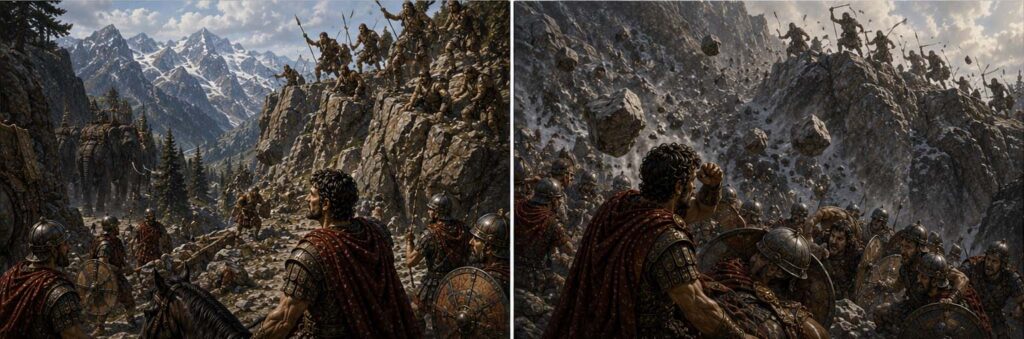
They waited at the top of the ridge without any single movement. When Hannibal ordered the column to continue, the clan warriors attacked fiercely. At the same time, Mago and his men emerged from their positions and started to engage the clansmen.
The clans warriors didn’t understand what happened. They suddenly fell into a trap, which was beyond their understanding. It supposed to be an easy ambush.
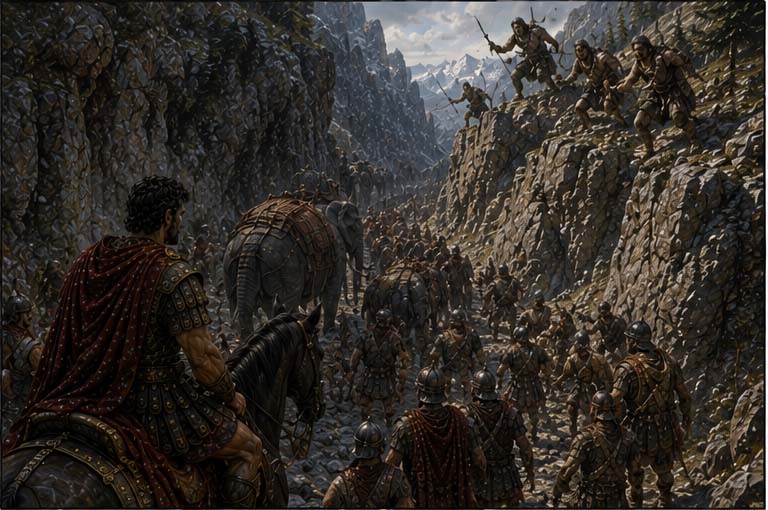
Shields collided at arm’s length, spears shattered against stone, and warriors fought desperately for every step of ground. Many of the Allobroges, trapped against the edge of the precipice, were forced backward until the mountain itself claimed them.
By midday the pass belonged to Carthage.
The losses were heavy but required to protect the army. No one had any complaint about the losses. Every soldier was aware of the situation.
They went on and on. For days the Carthaginian army had climbed ever deeper into the Alps. Each step forward demanded more from the men than the last. The mountains offered little mercy, yet at last a broad valley appeared, bringing with it an unexpected sight. A delegation from the Centrones emerged bearing gifts of cattle, food, and supplies. They even surrendered several hostages as a pledge of friendship, promising to guide Hannibal safely through the difficult mountain passes.